The Tertiary Color Yellowgreen Contains What Ratio of Yellow to Blue
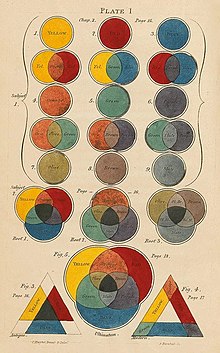
Page from A New Practical Treatise on the Three Primitive Colours Assumed as a Perfect System of Rudimentary Information by Charles Hayter.
A tertiary color or intermediate color is a color made by mixing full saturation of one primary color with half saturation of another primary color and none of a third primary color, in a given color space such as RGB,[1] CMYK (more modern) or RYB[2] (traditional).
Tertiary colors have general names, one set of names for the RGB color wheel and a different set for the RYB color wheel. These names are shown below.
Another definition of tertiary color is provided by color theorists such as Moses Harris[3] and Josef Albers,[4] who suggest that tertiary colors are created by intermixing pairs of secondary colors: orange-green, green-purple, purple-orange; or by intermixing complementary colors. This approach to tertiary color relates specifically to color in the form of paints, pigments, and dyes.
Comparison of RGB and RYB color wheels [edit]
The RYB color wheel was invented centuries before the 1890s, when it was found by experiment[ citation needed ] that magenta, yellow, and cyan are the primary colors of pigment, not red, yellow, and blue.
The RGB color wheel has largely replaced the traditional RYB color wheel because it is possible to display much brighter and more saturated colors using the primary and secondary colors of the RGB color wheel. In the terminology of color theory, RGB color space and CMY color space have a much larger color gamut than RYB color space.
RGB or CMYK primary, secondary, and tertiary colors [edit]

Primary, secondary, and tertiary colors of the RGB (CMY) color wheel.
The primary colors in an RGB color wheel are red, green, and blue, because these are the three additive colors—the primary colors of light. The secondary colors in an RGB color wheel are cyan, magenta, and yellow because these are the three subtractive colors—the primary colors of pigment.
The tertiary color names used in the descriptions of RGB (or equivalently CMYK) systems are shown below.
| red | (●) | + | yellow | (●) | = | orange | (●) |
| yellow | (●) | + | green | (●) | = | chartreuse | (●) |
| green | (●) | + | cyan | (●) | = | spring green | (●) |
| cyan | (●) | + | blue | (●) | = | azure | (●) |
| blue | (●) | + | magenta | (●) | = | violet | (●) |
| magenta | (●) | + | red | (●) | = | rose | (●) |
Tertiary-, quaternary-, and quinary- terms [edit]
The terms for the RGB tertiary colors are not set. The names for the twelve quaternary colors are more variable, if they exist at all, though indigo and scarlet are standard for blue–violet and red–vermilion.
|
|
|
Traditional painting (RYB) [edit]
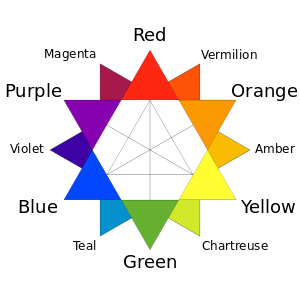
A traditional RYB color wheel.
The primary colors in an RYB color wheel are red, yellow, and blue. The secondary colors — orange, green, and purple — are made by combining the primary colors.
In the red–yellow–blue system as used in traditional painting and interior design, tertiary colors are typically named by combining the names of the adjacent primary and secondary.[5] [6]
| red | (●) | + | orange | (●) | = | vermilion (red-orange) | (●) |
| orange | (●) | + | yellow | (●) | = | amber (yellow-orange)[7] | (●) |
| yellow | (●) | + | green | (●) | = | chartreuse (yellow-green) | (●) |
| green | (●) | + | blue | (●) | = | teal (blue-green)[7] | (●) |
| blue | (●) | + | purple | (●) | = | violet (blue-purple) | (●) |
| purple | (●) | + | red | (●) | = | magenta (red-purple) | (●) |
Tertiary- and quaternary-color terms [edit]
The terms for the RYB tertiary colors are not set. For the six RYB hues intermediate between the RYB primary and secondary colors, the names amber/marigold (yellow–orange), vermilion/cinnabar (red–orange), magenta (red–purple), violet (blue–purple), teal/aqua (blue-green), and chartreuse/lime green (yellow–green) are commonly found. The names for the twelve quaternary colors are more variable, if they exist at all, though indigo and scarlet are standard for blue–violet and red–vermilion.
In another sense, a tertiary color is obtained by mixing secondary-colored pigments. These three colors are russet (orange–purple), slate (purple–green), and citron (green–orange), with the corresponding three quaternary colors plum (russet–slate), sage (slate–citron), buff (citron–russet) (with olive sometimes used for either slate or citron).[8] [9] Beyond that are shades of grey (blue grey and brown greys), which approach but never quite reach black.
The RYB color terminology outlined above and in the color samples shown below is ultimately derived from the 1835 book Chromatography, an analysis of the RYB color wheel by George Field, a chemist who specialized in pigments and dyes.[10]
|
|
|
|
|
|
See also [edit]
- Color wheel
- Color theory
References [edit]
- ^ Marcus Weise and Diana Weynand (2007). How Video Works. Focal Press. ISBN978-0-240-80933-5.
- ^ Stan Place and Bobbi Ray Madry (1990). The Art and Science of Professional Makeup. Thomson Delmar Learning. ISBN0-87350-361-9.
- ^ Moses Harris (1766). The Natural System of Colours. Laidler.
- ^ Josef Albers (1963). Interaction of Color. Yale University Press. ISBN0-300-01846-0.
- ^ Adrienne L. Zihlman (2001). The Human Evolution Coloring Book. HarperCollins. ISBN0-06-273717-1.
- ^ Kathleen Lochen Staiger (2006). The Oil Painting Course You've Always Wanted: Guided Lessons for Beginners and Experienced Artists. Watson-Guptill. ISBN0-8230-3259-0.
- ^ a b Susan Crabtree and Peter Beudert (1998). Scenic Art for the Theatre: History, Tools, and Techniques. Focal Press. ISBN0-240-80187-3.
- ^ William J. Miskella, 1928, Practical Color Simplified: A Handbook on Lacquering, Enameling, Coloring And Painting, pp
- ^ John Lemos, 1920, "Color Charts for the School Room", in School Arts, vol. 19, pp 580–584
- ^ Maerz and Paul (1930). A Dictionary of Color. New York. p. 154.
- ^ a b c RGB approximations of RYB tertiary colors, using cubic interpolation."Archived copy". Archived from the original on 2013-06-28. Retrieved 2012-12-29 .
{{cite web}}: CS1 maint: archived copy as title (link) The colors are paler than a simple mixture of paints would produce. For the darker, true secondary colors, see secondary color. Pure tertiary colors would be darker still.
Source: https://en.wikipedia.org/wiki/Tertiary_color
0 Response to "The Tertiary Color Yellowgreen Contains What Ratio of Yellow to Blue"
Post a Comment